

How To Repair Meniscus Root Tear
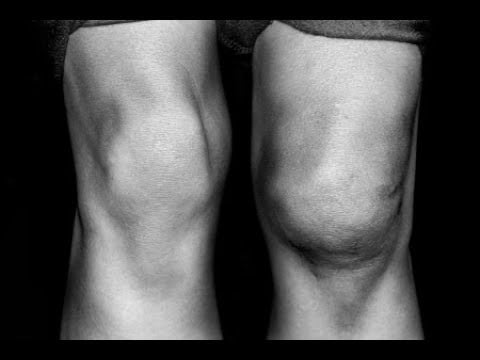
Meniscus tears occur frequently. Some meniscus tears are historic period-appropriate. Some are due to trauma or injury. The most common location for a meniscus tear is the posterior horn of the medial meniscus.
You've read your MRI report, and naturally, you're concerned. Many Orthopedic Surgeons consider certain posterior horn meniscus tears to be a normal age-appropriate change. Wait? What? Yes, certain meniscus tears are but part of the clothing and tear process. Many posterior horn meniscus tears are found in people without genu pain. But some meniscus tears do cause hurting. How practise we decide which meniscus tears may need surgery and which can exist treated without surgery? This post volition swoop deeper to answer your questions most tears of the posterior horn of the medial meniscus.
Despite being considered a common age-appropriate alter, some meniscus tears can exist a cause of knee pain. Many of you will recover from this episode of knee pain without surgery, yet some of you lot might exist considered a good candidate for surgery. How do we differentiate the two?
All meniscus tears are not viewed in the same manner. All meniscus tears are non treated the same. Some of the states run every mean solar day with known posterior horn tears. Therefore, certain meniscus tears can be safely ignored, even so some we may want to set up immediately? We will discuss all this in more detail.
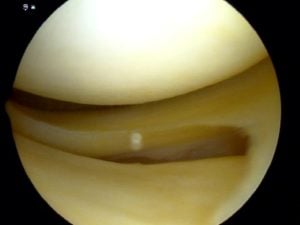
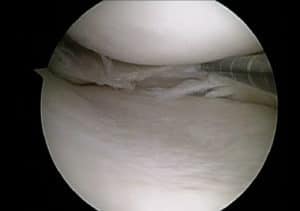
Tears of the meniscus can vary by location of the tear, the type of tear, size of the tear, and the corporeality of pain they produce.
How does the meniscus work?
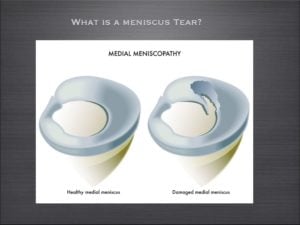
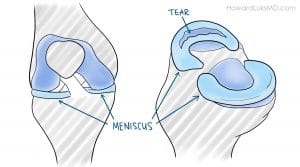
The meniscus is a C-shaped cartilage disk that is found in the human knee. We have two menisci in either human knee. Nosotros have the medial meniscus on the inner side of the knee and the lateral meniscus on the outer side of the knee joint. See this mail to larn more about how a meniscus functions.
The menisci serve a critical office in the knee joint as a shock absorber or cushion. This helps minimize the stress on another type of cartilage in the knee, which we telephone call the articular cartilage. If yous look at the image below, you lot see the meniscus in light bluish. Every bit the femur or thigh bone pushes down towards the tibia, the meniscus accepts a lot of the force. It deforms or pushes outward and dissipates a lot of the force from the femur before the femur contacts the tibia. This is how the meniscus protects the articular cartilage.
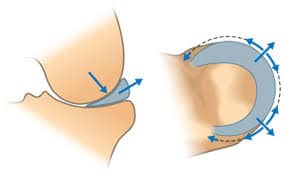
The articular cartilage coats the ends of our basic within a articulation. If the articular cartilage wears abroad, arthritis will occur. By protecting the articular cartilage, the meniscus helps prevent the onset of arthritis. Equally yous can see beneath, if the articular cartilage is subject field to likewise much force or load due to a meniscus tear then the cartilage can commencement to degenerate.
Causes of Posterior Horn Meniscus Tears
People tin can develop tears of the meniscus because of trauma or sports injuries. Believe information technology, or not most meniscus tears do not occur due to injury in middle-aged individuals. A meniscus can tear simply because it wore out. Most of you will not call back any specific injury. Some of you might remember that you bent downwardly to get something off the floor or from under the bed and felt a click or popular.
Either style, most posterior horn meniscus tears in adults are "complex" tears and did not occur because of an injury– they simply wore out. That is why many of us in the orthopedic community now view these as an age-appropriate change. We develop historic period-appropriate "tears" in other parts of our torso too, not all of them cause pain and almost do not crave surgery.
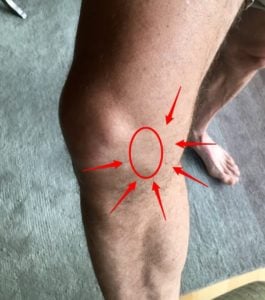
By far, the most common location for a tear is in the back and on the inner or medial side of the genu — that is the surface area we telephone call the posterior horn of the medial meniscus. The image below shows your human knee region where you may feel pain from a posterior horn tear.
The posterior horn is also the most common expanse for degenerative meniscus tears where the meniscus tissue simply wore out. These degenerative posterior horn meniscus tears are found in many runners- and often practise non need surgery.
Treatments for Posterior Horn Medial Meniscus Tears
As mentioned in my recent postal service, the majority of posterior horn tears are determined to be degenerative. These degenerative tears are usually managed without the demand for surgery. It's truthful… many of you with a degenerative meniscus tear probably had the tear long before your knee started hurting. And in nigh instances, y'all volition be able to return to activities without the demand for surgery.
It may take 2-six months for the pain to go abroad, but this is worth waiting for. People who have surgery on these circuitous degenerative posterior horn tears are at higher gamble of developing arthritis than those treated with surgery. Again… truth. Having the meniscus removed, a procedure we call a partial menisectomy will increase your hazard of developing arthritis. Were you told that these tears will increment your take chances of developing osteoarthritis and that surgery will foreclose that? Well, that'due south just not what the research shows.
The onset of knee pain is multi-factorial. That means it is due to many different things. Sometimes our knees just get cranky or upset. Synovitis or inflammation of the inside of the knee develops. This volition subside in time… but if you rush to your doctor and they society an MRI, they might find a meniscus tear. Now you lot might discover yourself fast-tracked to surgery. Also… you lot cannot unsee your MRI report.
Every bit with almost forms of knee pain in a middle-aged developed, focusing on strength, rest, and muscle mass volition assist most of you get through this episode of hurting without needing surgery. This postal service talks about the importance of rest training and strengthening- it contains a few videos to guide you likewise.
Walking, jogging, cycling, etc., volition not cause harm. When yous are comfortable, yous should return to those activities.
Muscle mass.. or larger muscles are associated with longevity and better health. Yes, our muscles contribute enormously to our overall well-being past aiding in our metabolism and glucose control. The stronger your legs are, the less probable they are to bother you.
Many of yous who have posterior horn tears might besides have some evidence of osteoarthritis. This is non a terminal diagnosis! Physical activeness should not be avoided because there is very fiddling chance that well-nigh exercises will make your tear or arthritis worse. You don't want your risk of heart disease, stroke, and dementia to increment considering you lot stopped exercising, thinking that you lot are protecting the knee. This mail goes into considerable item about managing a knee with arthritis and a complex or degenerative meniscus tear.
The majority of yous who have a degenerative meniscus tear will practice very well without surgical direction. Again, it may have ii-vi months. If it'south two weeks out from the onset of hurting and you are told to consider surgery, it is often in your all-time involvement to wait. The body heals far more than slowly than we retrieve.
Many of you volition see improvement in your pain with the use of a compression knee sleeve. Just considering something is torn doesn't always hateful that it needs to be "stock-still." Surgery for meniscus tears is not always necessary. Cold/water ice pinch can help when the hurting is awful. This is particularly true for a "degenerative" posterior horn medial meniscus tear.
On the other hand, "Flap tears," "bucket-handle tears," and other larger tears of the meniscus are more than likely to lead to surgery because of the persistent hurting and mechanical symptoms such as popping locking and instability.
Posterior horn medial meniscus tears in children tend to lead to a recommendation to consider surgery since these tears are normally repairable. That means that nosotros can suture the tear back together. In addition, children have much more regenerative or healing potential. If a meniscus tear is repaired (sutured back together), and then the run a risk of developing arthritis later in life drops significantly.
Generally speaking, the treatment options for meniscus tears include:
- rest,
- physical therapy,
- activity modification, and
- occasionally a surgery nosotros refer to every bit an arthroscopy.
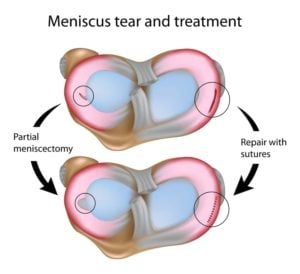
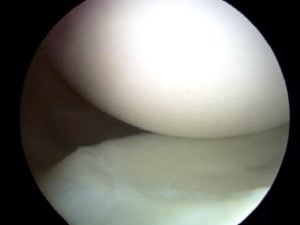
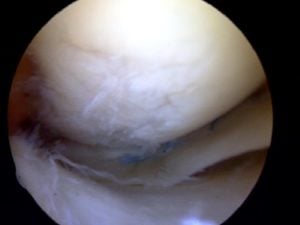
An arthroscopy involves placing a pocket-sized fiber-optic photographic camera into the knee through a 1/4 inch incision. The camera can visualize the meniscus and other structures inside the knee. During an arthroscopy, we have the choice of either repairing the meniscus tear or removing the torn piece.
Arthroscopy for Medial Meniscus Tears
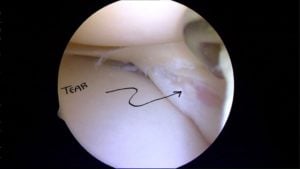 The conclusion to repair or remove the torn portion is made at the time of surgery. Nosotros demand to run into whether or not the meniscus is repairable based on its quality, location, and size. Preference is given to repair posterior horn medial meniscus tears, if possible, to help preserve the meniscus and minimize the take a chance of developing arthritis.
Additional Reading on Meniscal Tears:
- What is a Meniscus?
- Types of Meniscus Tears
- Why practice meniscus tears hurt?
- Do all meniscus tears require surgery?
- Recovery from meniscus tear surgery.
Source: https://www.howardluksmd.com/posterior-horn-medial-meniscus-tears/
0 Response to "How To Repair Meniscus Root Tear"
Post a Comment